
‘Schools face “sound basic” showdown’
Feb. 1, 2024
The following update on the upcoming NC Supreme Court review of the Leandro litigation was published Feb. 1, 2024 by the N.C. Council of Churches. It was written by Steve Ford, retired editorial page editor of the Raleigh News & Observer and the Council’s former Volunteer Program Associate.
In a political climate less driven by conservative ideology, even within our judicial system’s upper reaches, it might be reckless to forecast how the latest, epic clash over proper funding for North Carolina’s public schools – how much and who decides –will unfold in the state Supreme Court.
But that climate characterizes the time we live in – sadly enough, many of us would say. And so the grim prediction must be made: When the high court weighs the current arguments pitting Republican leaders of the General Assembly against advocates for more equitable and effective public schools, the decades-long push to require a significant boost in statewide school investment under the court’s auspices likely will be blocked — dispatched to the legal junk yard.
That outcome, in the wake of a court hearing set for February 22, would spell the end of a saga stretching back to 1994, when a lawsuit on behalf of students in five of the state’s least affluent counties first sought to establish a constitutional right to public schools with sufficient resources to accomplish their vital mission.
Over the ensuing years, in what became known as the Leandro cases, the Supreme Court first interpreted the state constitution as guaranteeing every student a fair chance to get a “sound basic” education, meaning one that offers a genuine path toward a successful life and responsible citizenship.
The court then considered exhaustive findings at the trial level in concluding that many students throughout the state were being deprived of that opportunity. The remedy, the court stipulated, must involve state action to improve schools across the board.
Yet the General Assembly, protecting what majority Republicans say are their sole prerogatives to allocate money from the state treasury and also to determine education policy, has resisted the court’s attempt to provide more school spending, whether by choice or by mandate.
That’s the heart of the conflict now coming to a head – with Republican justices who have taken control of the high court poised to side with ideological allies in the legislature and to reverse rulings by their Democratic predecessors.
About face!
The previous court majority, with a 4-3 Democratic margin, aimed to have the last word when it agreed in November 2022 that the state should be compelled to begin funding an eight-year school improvement plan supported both by lawsuit plaintiffs and state education officials.
But things didn’t go well for Democratic judicial candidates in the election held four days after that ruling came down. With a conservative tide running strong, Republicans emerged with a 5-2 Supreme Court edge. And the new majority promptly turned to dismantling some of the prior court’s signature decisions.
Their first order of business in early 2023 was to countermand an opinion aimed at curbing extreme partisan gerrymandering – a tactic embraced by Republican legislators so as to solidify their hold on power – and to reinstate a photo ID requirement that could shrink Democratic vote totals.
Indeed, they moved with almost shocking alacrity, as if the laws themselves had changed along with the court’s makeup. Criticism was shrugged aside with assertions that, well, opinions rendered by the Democratic justices were just plain wrong and had to be corrected. If the U.S. Supreme Court’s disavowal of long-established abortion rights as it overturned Roe vs. Wade a few months earlier was a template for this kind of unseemly pivot, perhaps that’s no coincidence.
The Democratic justices had recognized that the two-year state budget to be developed in 2023 would include some of the spending envisioned under the first phase of the so-called Comprehensive Remedial Plan, or CRP. But not all of it. So trial-court judges were tasked with determining the shortfall.
As most recently reckoned, the amount at issue stands at $677 million – essentially a down payment that the state would be required to plow into school staffing and other resources. Attorneys for top legislative Republicans, in a brief filed in November, say that the transfer order should be nullified. Among their contentions is that the courts have no business determining how state funds should be spent.
Further, they maintain that the current Supreme Court should throw out all the previous rulings that have a statewide scope. They say findings of educational deficiencies were actually limited to Hoke County, where conditions were closely examined in a trial setting, and thus should have no legal bearing elsewhere (Halifax County being an exception because of a separate proceeding to address deficiencies there).
“The lack of a judgment establishing the existence of a violation anywhere other than Hoke and Halifax Counties means the Court lacked jurisdiction to order the CRP,” the brief asserts. “Indeed, in issuing a purported ‘remedy’ without any judgment establishing the existence of a violation, the court entered what amounts to a mere ‘advisory’ order by purporting to dictate necessary measures to provide for the State’s education system in the absence of any claim or judgment rendering such an order necessary.”
Bench signals
It would hardly be a surprise if the author of that brief had taken cues from Justice Phil Berger Jr., who concurred in the October order that stipulated the case would be revisited. Berger — whose father, the state Senate’s Republican leader, is a party to the proceedings – explained the need for a do-over by saying the previous Supreme Court had failed to untangle issues surrounding proper jurisdiction and adequate trial court review.
Dissenting from that order, Justice Anita Earls contended that questions of jurisdiction had been resolved at the trial level, where it was found that the opportunity to obtain a sound basic education was lacking not just in Hoke County but was “pervasive statewide.” And that calls for a statewide remedy, Earls wrote.
Rehashing the issues raised by Berger at this stage – and meanwhile with the only material change having been in the high court’s membership – would “sow chaos and snuff out legal finality,” said Earls. Her dissent was joined by Justice Allison Riggs, appointed by Gov. Roy Cooper in September to fill a vacancy.
Berger virtually sneered at that warning. “Once again, we endure ad nauseum these fanciful protestations,” he wrote. “In its rush to publish an opinion in the prior matter, the majority declined to address fundamental subject matter jurisdiction questions. To be sure, these issues were raised, but the majority chose to ignore the bedrock legal principle that courts must examine jurisdiction to act. Even legal neophytes understand that subject matter jurisdiction can never be waived and can be raised at any time.”
For his part, Chief Justice Paul Newby – who was in the minority along with Berger and Justice Tamara Barringer when the previous court agreed that the remedial plan should be funded – has voiced doubts that the findings of unconstitutional school deficiencies can legally be extrapolated beyond the counties where the Leandro lawsuit originated.
Plaintiffs in the case spelled out their views, countering objections to a compulsory statewide school improvement effort, in a brief filed on Jan. 10.
There’s of course nothing wrong with scrutinizing the legal underpinnings of a case and ensuring that it’s conducted by the book. But to the extent that they align with their fellow Republicans in the legislature, whose skepticism toward the entire public education enterprise runs wide and deep, Newby and his colleagues now in the majority risk missing the educational forest for the legal trees.
The forest, it can be said, consists of the many schools across the state that struggle to keep another generation of schoolkids from languishing because of shortages of well-qualified school personnel, shortages of educational supplies, rundown facilities. Such problems especially afflict schools with high percentages of students from impoverished backgrounds, whether in remote rural areas or inner cities.
North Carolina’s constitution, which guarantees the privilege of public education, logically can be read as requiring education to offer a certain level of quality to be meaningful. Geography should be no constraint. It is to uphold that promise that public school advocates have followed their long, winding road through the courts all these years.
Those who stand in solidarity out of a belief that education is a keystone to individual fulfillment and a healthy society – including the N.C. Council of Churches – can hope that the Supreme Court recognizes the true stakes for our state’s young people as it reconsiders the school funding mandate. We who anticipate the worst would be glad to be proven wrong.

Rev. Darius L. Swann dies
New proof of need to be ‘breaking the link’ between poverty and achievement
 April 11, 2018
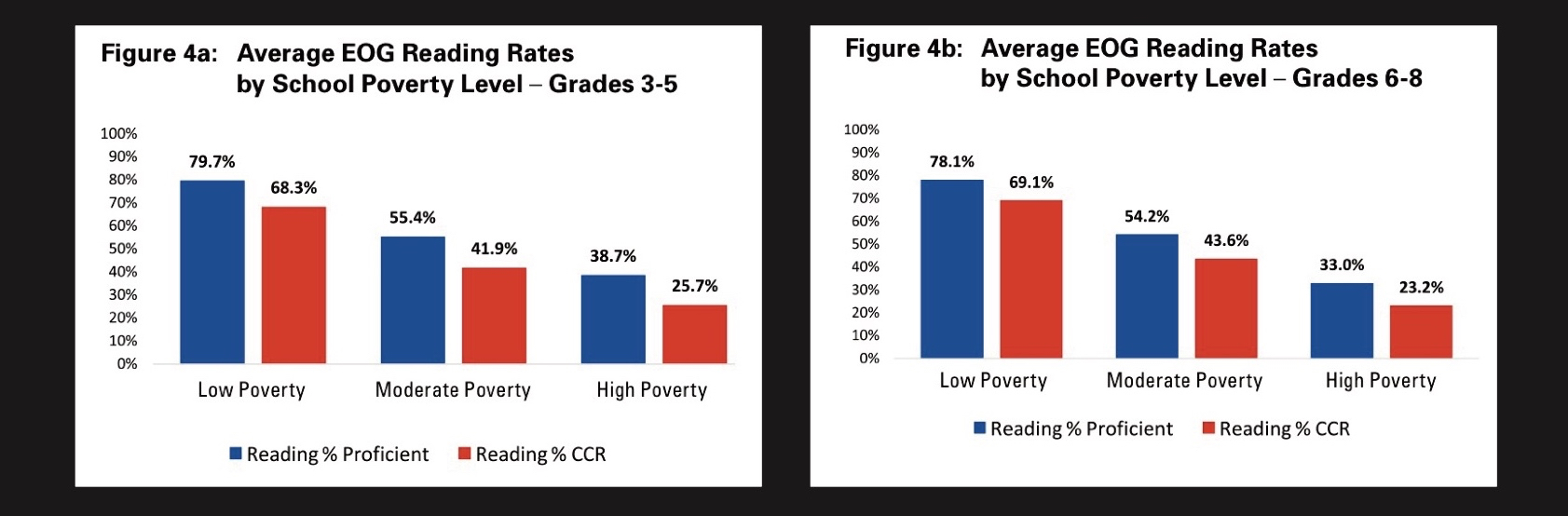
From “Breaking the Link”, CMS, February 2018: systemwide reading results from year 2016-2017, percentage of children in grades 3-5 and 6-8 who are reading proficiently (the minimum for being on-grade-level) and CCR (college- and career-ready), with schools categorized in three roughly equivalent-sized groups: low poverty (0%-24%; 57 schools); moderate poverty (25%-50%; 57 schools; high poverty (51%+; 56 schools).
Download the full report in English or Spanish.
“The Trump/Sanders era is going to create new opposition blocs, filled with people who never thought they would be working together.”
– David Brooks in the Times, Nov. 29, 2016
Looking for an item posted here earlier? Click here for the Archive.